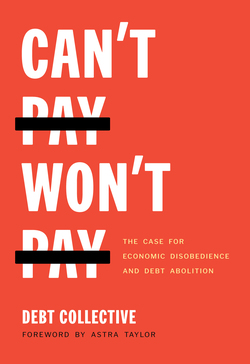
Debtors have been mocked, scolded and lied to for decades. We have been told that it is perfectly normal to go into debt to get medical care, to go to school, or even to pay for our own incarceration. We’ve been told there is no way to change an economy that pushes the majority of people into debt while a small minority hoard wealth and power.
The coronavirus pandemic has revealed that mass indebtedness and extreme inequality are a political choice. In the early days of the crisis, elected officials drew up plans to spend trillions of dollars. The only question was: where would the money go and who would benefit from the bailout?
The truth is that there has never been a lack of money for things like housing, education and health care. Millions of people never needed to be forced into debt for those things in the first place.
Armed with this knowledge, a militant debtors movement has the potential to rewrite the contract and assure that no one has to mortgage their future to survive.
Debtors of the World Must Unite.
As isolated individuals, debtors have little influence. But as a bloc, we can leverage our debts and devise new tactics to challenge the corporate creditor class and help win reparative, universal public goods.
Individually, our debts overwhelm us. But together, our debts can make us powerful.
Astra Taylor is a documentary filmmaker, writer, and political organizer. She is the director, most recently, of What Is Democracy? and the author of Democracy May Not Exist, but We’ll Miss It When It’s Gone and the American Book Award winning The People’s Platform: Taking Back Power and Culture in the Digital Age. She is co-founder of the Debt Collective, a union for debtors, and contributed the foreword to the group’s new book, Can’t Pay, Won’t Pay: The Case for Economic Disobedience and Debt Abolition.
Publication date: October 20, 2020
Chapter 1 You are Not a Loan: Recognizing our Power in the Age of Debt
Chapter 2 How Did We Get Here? Different Histories for Different Futures
Chapter 3 Debt Strike! Households, Cities, Empires
Chapter 4 Disrupting Dystopia: Algorithmic Extraction and Digital Redlining
Chapter 5 The Future of Finance: Economic Disobedience and Reparative Public Goods
"The Debt Collective’s Student Debt Strike is an important campaign to help build the mass movement we need to resist and abolish student debt." —Rep. Rashida Tlaib"Can’t Pay, Won’t Pay is less about the mechanics of finance than their meaning in the lives of billions of people around the world. And it is from this focus on personal meaning that the book derives its political power, plucking an identity that is associated with so much shame and silent suffering, and charging it with a new collective power to throw sand in the gears of capitalism." —Jacobin
"A quick and accessible read...an impassioned call to action." —Hyperallergic
"By prioritizing redress and repair, we can win free and universal education, housing, and healthcare. No one should have to go into debt to meet their basic needs,’ Debt Collective declares in this urgent book, which lays out concrete strategies and a powerful vision for radical change." —Keeanga-Yamahtta Taylor
"This book explains why we are overdue for a debt revolution and, more importantly, how to do it. To abolish debt is to begin to rebuild society. We need to start doing so now." —David Graeber
"The Debt Collective has given us a visionary roadmap for forming an army of debtors that is powerful enough to make capital scream." —Naomi Klein
"Defusing explosive debts and undermining the legitimacy of the punitive, profitable debt system of the current United States is insurrectionary work, and uniting debtors in common cause is solidarity and justice work. This anticapitalist manual is a beautiful guide to how and why to do all those things." —Rebecca Solnit
"The Debt Collective turns a sense of entrapment into a collective call for liberation." —Stephanie Kelton
"This timely and outstanding book demonstrates the many predatory ways that debt stifles mobility for the most economically vulnerable. Fortunately it does not conclude there, but presents a political pathway. Through solidarity and collective action, debtor unions can forge a new economy that prioritizes finance working for all people, rather than our most vulnerable working for finance." —Darrick Hamilton
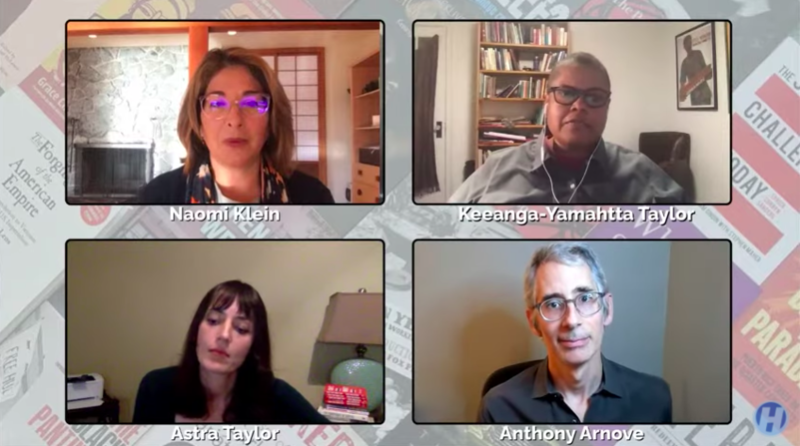
On Friday, November 6th, Naomi Klein, Astra Taylor and Keeanga-Yamahtta Taylor joined Haymarket's Anthony Arnove for a conversation about next steps for the struggle in the aftermath of the 2020 election and the ongoing crisis. Here, we present a transcript of their discussion.
Join Haymarket Books for a series of online events hosted in the context of the current crisis, and watch past events.