Marxism and Social Movements
Description
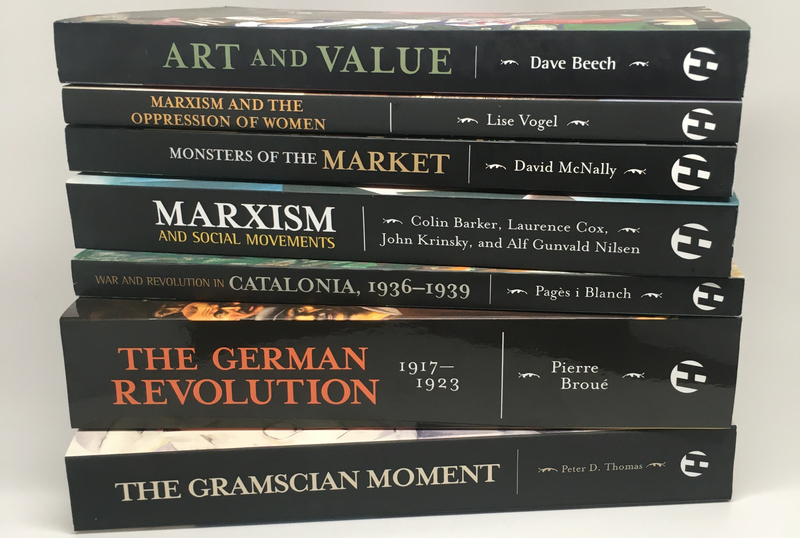
Marxism and Social Movements is the first sustained engagement between social-movement theory and Marxist approaches to collective action. The chapters collected here, by leading figures in both fields, discuss the potential for a Marxist theory of social movements. Exploring struggles on six continents over 150 years, it sets a new agenda both for Marxist theory and for movement research.
Author Bios
Colin Barker is an honorary lecturer in sociology at Manchester Metropolitan University. He co-organizes annual international conferences on Alternative Futures and Popular Protest. He has published many books and articles on social movements and revolutions and is an active socialist.
Laurence Cox co-directs the MA in Community Education, Equality and Social Activism at Maynooth. He co-edits the social movement journal Interface and has also published Understanding European Movements (Routledge, 2013, with Cristina Flesher Fominaya).
John Krinsky is associate professor of political science at The City College of New York. He co-edits the journal Social Movement Studies, and published Free Labor: Workfare and the Contested Language of Neoliberalism (Chicago 2007).
Alf Gunvald Nilsen is associate professor of sociology at the University of Bergen. He co-edits the journal Interface and has published widely on social movements. He is the author of Dispossession and Resistance in India (Routledge, 2010).
More Info
Publication date: April 29, 2014
Table of Contents
Marxism and Social Movements: An Introduction, Colin Barker, Laurence Cox, John Krinsky and Alf Gunvald Nilsen
PART 1: THEORETICAL FRAMEWORKS
Marxism and Social Movements
1. Class-Struggle and Social Movements, Colin Barker
2. What Would a Marxist Theory of Social Movements Look Like?, Alf Gunvald Nilsen and Laurence Cox
Social-Movements Studies and its Discontents
3. The Strange Disappearance of Capitalism from Social-Movement Studies, Gabriel Hetland and Jeff Goodwin
4. Marxism and the Politics of Possibility: Beyond Academic Boundaries, John Krinsky
PART 2: HOW SOCIAL MOVEMENTS WORK
Developmental Perspectives on Social Movements
1. Eppur Si Muove: Thinking ‘The Social Movement’, Laurence Cox
2. Class-Formation and the Labour-Movement in Revolutionary China, Marc Blecher
3. Contesting the Postcolonial Development-Project: A Marxist Perspective on Popular Resistance in the Narmada Valley, Alf Gunvald Nilsen
The Politics of Social Movements
4. The Marxist Rank-And-File/Bureaucracy Analysis of Trade-Unionism: Some Implications for the Study of Social-Movement Organisations, Ralph Darlington
5. Defending Place, Remaking Space: Social Movements in Oaxaca and Chiapas, Chris Hesketh
6. Uneven and Combined Marxism within South Africa’s Urban Social Movements, Patrick Bond, Ashwin Desai and Trevor Ngwane
PART 3: SEEING THE BIGGER PICTURE
Comparative-Historical Perspective
1. Thinking About (New) Social Movements: Some Insights from the British Marxist Historians, Paul Blackledge
2. Right-Wing Social Movements: The Political Indeterminacy Of Mass Mobilisation, Neil Davidson
3. Class, Caste, Colonial Rule, And Resistance: The Revolt of 1857 In India, Hira Singh
4. The Black International as Social-Movement Wave: C.L.R. James’s History of Pan-African Revolt, Christian Høgsbjerg
Social Movements against Neoliberalism
5. Language, Marxism and the Grasping of Policy-Agendas: Neoliberalism and Political Voice in Scotland’s Poorest Communities, Chik Collins
6. Organic Intellectuals in the Australian Global-Justice Movement: The Weight of 9/11, Elizabeth Humphrys
7. ‘Disorganisation’ as Social-Movement Tactic: Reappropriating Politics During the Crisis of Neoliberal Capitalism, Heike Schaumberg
8. ‘Unity of The Diverse’: Working-Class Formations and Popular Uprisings From Cochabamba to Cairo, David McNally
References