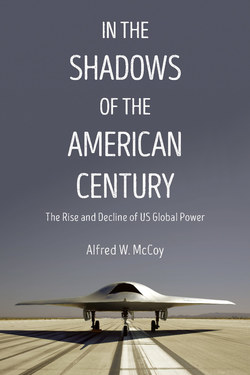
In a tempestuous narrative that sweeps across five continents and seven centuries, this book explains how a succession of catastrophes—from the devastating Black Death of 1350 through the coming climate crisis of 2050—has produced a relentless succession of rising empires and fading world orders.
During the long centuries of Iberian and British imperial rule, the quest for new forms of energy led to the development of the colonial sugar plantation as a uniquely profitable kind of commerce. In a time when issues of race and social justice have arisen with pressing urgency, the book explains how the plantation’s extraordinary profitability relied on a production system that literally worked the slaves to death, creating an insatiable appetite for new captives that made the African slave trade a central feature of modern capitalism for over four centuries.
After surveying past centuries roiled by imperial wars, national revolutions, and the struggle for human rights, the closing chapters use those hard-won insights to peer through the present and into the future. By rendering often-opaque environmental science in lucid prose, the book explains how climate change and changing world orders will shape the life opportunities for younger generations, born at the start of this century, during the coming decades that will serve as the signposts of their lives—2030, 2050, 2070, and beyond.
Alfred W. McCoy holds the Harrington Chair in History at the University of Wisconsin-Madison. After earning his Ph.D. in Southeast Asian history at Yale in 1977, his writing has focused on Philippine political history, the history of modern empires, and the covert netherworld of illicit drugs, syndicate crime, and state security.
His first book, The Politics of Heroin in Southeast Asia (1972), sparked controversy over the CIA’s attempt to block its publication. But it is now regarded as the “classic” study of global drug trafficking, translated into nine languages and remaining in print continuously for nearly 50 years. His book A Question of Torture: CIA Interrogation, From the Cold War to the War on Terror (2006) provided the historical dimension for the Oscar-winning documentary feature, Taxi to the Darkside.
McCoy's book, Policing America’s Empire: The United States, the Philippines, and the Rise of the Surveillance State (2009), was the winner of the Kahin Prize from the Association for Asian Studies, explores the pervasive influence of internal security in these two states. He is also the author of In the Shadows of the American Empire: The Rise and Decline of US Global Power (2017). His latest book, To Govern the Globe: World Order and Catastrophic Change (2021), charts the succession of world empires from the Black Death of 1350 through the coming climate crisis of 2050.
His books on the Philippines have won that country’s National Book Award (1985, 1995, 2001), as well as the Goodman Prize (2001) from the Association for Asian Studies. His scholarship has been recognized by the Wilbur Cross Medal from Yale University and the Hilldale Award for Arts & Humanities from the University of Wisconsin-Madison (2012).
Publication date: June 6, 2023
"An ambitious effort to discern patterns in the rise and fall of world empires.... McCoy’s account is compelling...with many provocative observations on world history and its present twists." —Kirkus
"To Govern the Globe is a brilliant distillation of 700 years of geopolitics, exposing how we arrived where we are, amidst the worsening climate crisis and collapsing world orders. Al McCoy’s eloquently written book is a call to action for us all, as time still remains to prevent an unprecedented cascade of catastrophes." —Amy Goodman, host of "Democracy Now!"
"McCoy is one of the most eminent scholars in the world on the abuse of power and authority, on surveillance and repression, on the historical evolution of state-sanctioned torture in the US and elsewhere, and, more recently, on the rapidly declining state of the US empire. McCoy’s latest book “To Govern the Globe” is a formidable work of scholarship spanning an incredible arc of world history. Yet it is a gripping and fast-paced read that manages to distill the complex history of the rise and fall of world empires into a gripping narrative that is simultaneously exhilarating and terrifying. The book’s scope is so massive that only a scholar of McCoy’s skill could even consider attempting to capture it. McCoy’s meticulous understanding of the past and present failures and excesses of empires gives him the rare credibility to offer a detailed, damning picture of the grim realities humankind faces as history transforms into our future. After reading “To Govern the Globe,” however, I must conclude that embedded within McCoy’s book is a ray of hope demanding to be seen by us all before it’s truly too late.” —Jeremy Scahill, investigative journalists and author of Blackwater and Dirty Wars
“McCoy’s argument is meticulously footnoted and his sobering conclusions appear firmly grounded in data. The past may not be the best predictor of the future, but as McCoy notes, “the past remains our best means of understanding the present and our only viable guide to the future.” —California Review of Books
"To Govern the Globe can be read as a clarion call to take action." —The Arts Fuse
"A fascinating look at the rise and fall of empires and what it means for world orders. From colonial exploitation and capitalist ravaging of people and planet to arms racing and warfare, Alfred McCoy offers a deep dive into how this history has led to the climate crisis, and the impacts it will have on our future." —Ray Acheson, disarmament program director at the Women’s International League for Peace and Freedom
“In an age where most scholars concentrate on a limited specialty, no one sees a bigger picture more brilliantly than Alfred McCoy. In this powerful, enlightening, and frightening book he gives us a magisterial view of the empires of the past—and of the force in our future which promises to dwarf them all.” —Adam Hochschild, author of King Leopold's Ghost
"To Govern the Globe is history on an epic scale -- sweeping, provocative, and unsparing in its judgments. Alfred McCoy's immensely readable narrative spans centuries, charting the rise and fall of successive world orders down to our own present moment shaped by China's emergence as a great power and the blight of climate change." —Andrew Bacevich, author of After the Apocalypse: America's Role in a World Transformed
"It’s hard to believe a book spanning seven centuries could be so timely. Yet, Alfred McCoy’s probing and original study links the fate of multiple empires—including Pax Americana—to the all-too-relevant histories of protracted war, brutal exploitation, and catastrophic medical, environmental, and demographic crises." —Christian G. Appy, author of American Reckoning: The Vietnam War and Our National Identity

Haymarket Books LIVE has now produced several hundred events aimed at fostering struggle, solidarity, and debate. Follow Haymarket on Eventbrite to make sure you never miss an event. Past events can be browsed as videos on our YouTube channel or as audio on our Apple Podcast feed (or wherever you listen to your podcasts).
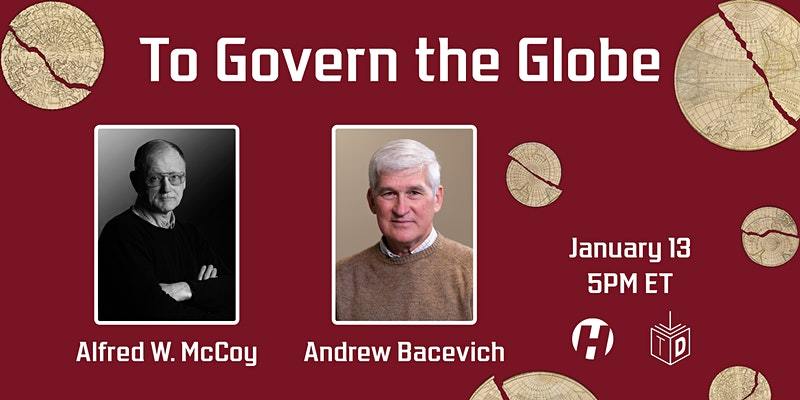
Join world-renowned historians to discuss Alfred W. McCoy's latest book, To Govern the Globe: World Orders and Catastrophic Change.