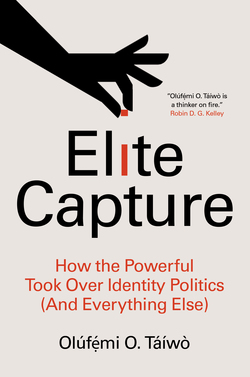
Un ensayo clave del filósofo Olúfẹ́mi O. Táíwò para comprender cómo las élites se han apropiado de las políticas de identidad y sus usos.
¿Cómo podemos entender la política de la identidad? ¿Nos encontramos ante una versión inofensiva de la política de izquierdas? ¿O tal vez se trata de algo más inquietante y el término se ha convertido en una herramienta de la burguesía para mantener su dominio de clase? ¿Es la política de la identidad, encarnada en la teoría crítica de la raza, una ideología peligrosa, una amenaza para el orden establecido que los poderes fácticos intentan erradicar?
A partir de ejemplos de pensadores y activistas comprometidos con la tradición radical negra global —E. Franklin Frazier, Carter G. Woodson, Lilica Boa, Paulo Freire y Andaiye— y desde una comprensión crítica del capitalismo racial, el filósofo Olúfẹḿi O. Táíwò analiza el proceso en que las élites saquean el potencial político y emancipatorio de las políticas de la identidad y lo manipulan para controlar aspectos fundamentales de nuestro sistema social.
Pero si las élites se han apoderado de todo, ¿qué queda? ¿Cómo podemos ganar en un mundo tan viciado y empeñado? Táíwò es categórico: no basta denunciar. Con una pluma punzante y determinada, el autor propone como alternativa una política constructiva de solidaridad radical y reivindica la posibilidad de organización para desarticular el sistema perpetuado por los poderosos. En sus propias palabras, El saqueo de las élites es un libro “dirigido a quienes desean resultados diferentes, a quienes aspiran a un sistema-mundo distinto y mejor que el actual.”
“Identity politics” is everywhere, polarizing discourse from the campaign trail to the classroom and amplifying antagonisms in the media, both online and off. But the compulsively referenced phrase bears little resemblance to the concept as first introduced by the radical Black feminist Combahee River Collective. While the Collective articulated a political viewpoint grounded in their own position as Black lesbians with the explicit aim of building solidarity across lines of difference, identity politics is now frequently weaponized as a means of closing ranks around ever-narrower conceptions of group interests.
But the trouble, Olúfẹ́mi O. Táíwò deftly argues, is not with identity politics itself. Through a substantive engagement with the global Black radical tradition and a critical understanding of racial capitalism, Táíwò identifies the process by which a radical concept can be stripped of its political substance and liberatory potential by becoming the victim of elite capture—deployed by political, social, and economic elites in the service of their own interests.
Táíwò’s crucial intervention both elucidates this complex process and helps us move beyond a binary of “class” vs. “race.” By rejecting elitist identity politics in favor of a constructive politics of radical solidarity, he advances the possibility of organizing across our differences in the urgent struggle for a better world.
Olúfẹ́mi O. Táíwò is Associate Professor of Philosophy at Georgetown University. He received his Ph.D. in philosophy at the University of California Los Angeles. He has published in academic journals ranging from Public Affairs Quarterly, One Earth, Philosophical Papers, and the American Philosophical Association newsletter Philosophy and the Black Experience.
Táíwò’s theoretical work draws liberally from the Black radical tradition, anti-colonial thought, German transcendental philosophy, contemporary philosophy of language, contemporary social science, and histories of activism and activist thinkers.
His public philosophy, including articles exploring intersections of climate justice and colonialism, has been featured in The New Yorker, The Nation, Boston Review, Dissent, The Appeal, Slate, Al Jazeera, The New Republic, Aeon, and Foreign Policy.
He is the author of the book Reconsidering Reparations, published by Oxford University Press.
Publication date: February 9, 2027
Introducción
La apropiación de las élites
Comprender la coyuntura
Habitar los espacios
Reconstruir la casa común
Lo importante es transformar el mundo
“Olúfémi Táíwò is a thinker on fire. He not only calls out empire for shrouding its bloodied hands in the cloth of magical thinking but calls on all of us to do the same. Elite capture, after all, is about turning oppression and its cure into a (neo)liberal commodity exchange where identities become capitalism’s latest currency rather than the grounds for revolutionary transformation. The lesson is clear: only when we think for ourselves and act with each other, together in deep, dynamic, and difficult solidarity, can we begin to remake the world.”
—Robin D. G. Kelley, author of Freedom Dreams: The Black Radical Imagination
“Among the churn of books on ‘wokeness’ and ‘political correctness,’ philosopher Olúfẹ́mi O. Táíwò’s Elite Capture clearly stands out. With calm, clarity, erudition, and authority, Táíwò walks the reader through the morass, deftly explicating the distinction between substantive and worthy critique and weaponized backlash. Understanding the culture wars is essential to US politics right now, and no one has done it better than Táíwò in this book.”
—Jason Stanley, author of How Fascism Works
“With global breath, clarity and precision, Olúfẹ́mi O. Táíwò dissects the causes and consequences of elite capture and charts an alternative constructive politics for our time. The result is an erudite yet accessible book that draws widely on the rich traditions of black and anticolonial political thought.”
—Adom Getachew, author of Worldmaking after Empire: The Rise and Fall of Self-Determination